
Estimated total budget
$0
$292/guest national average
Life Events
Data last verified: September 2026 · Built by Muhammad Ayaz Akhtar
Work out a realistic wedding budget before you start booking vendors. Enter your guest count and this calculator estimates a total budget and catering cost, based on a real national survey of over 10,000 U.S. weddings, not a guessed number.
Estimated total budget
$0
$292/guest national average
Estimated catering cost
$0
$80/guest national average
Typical average cost by category
These are independent national averages among couples who booked each item, not a breakdown of your total, see "How this calculator works" below for why they do not add up to your estimate.
| Category | Average cost |
|---|---|
| Reception venue | $12,900 |
| Catering | $80 / guest |
| Live band | $4,500 |
| DJ | $1,800 |
| Photographer | $3,000 |
| Videographer | $2,300 |
| Wedding rings | $3,000 |
| Flowers | $2,800 |
| Alcohol | $2,800 |
| Event planner | $2,100 |
| Wedding dress | $2,100 |
| Event rentals | $2,000 |
| Lighting and decor | $1,900 |
| Transportation | $1,100 |
| Wedding cake | $540 |
| Invitations and stationery | $510 |
| Favors | $480 |
Based on The Knot 2026 Real Weddings Study (10,474 U.S. couples, married 2025). Actual costs vary widely by region, season, and choices, treat this as a planning benchmark, not a quote.
Based on The Knot 2026 Real Weddings Study (10,474 U.S. couples, married 2025), not a guessed average.
"What should we budget for our wedding?" gets answered online with either a flat number that ignores your guest list entirely, or a vague "it depends." This calculator uses a real national survey instead: The Knot's 2026 Real Weddings Study, based on 10,474 U.S. couples married in 2025, the largest and most current wedding-cost dataset available.[1]
The average is exactly that, an average based on real weddings today. Actual costs vary significantly by location, season, and guest count.[1]
Below the calculator, a reference table lists average costs for individual categories: venue, photographer, flowers, and so on. Adding every category in that table together comes to roughly $53,000, well above the $34,200 average total. That is not a mistake, it means each figure is an independent average among the couples who booked that specific item, not a slice of one shared budget. Not every couple hires a live band and a DJ, or a wedding planner, so summing every category would double-count. Use the table as "what couples who booked this typically paid," not as a percentage breakdown of your own number.
| Figure | Value |
|---|---|
| Average total wedding cost | $34,200 |
| Average guest count | 117 |
| Average cost per guest | $292 |
| Study sample size | 10,474 U.S. couples |
The $34,200 average covers the wedding day itself. It does not include the engagement ring, rehearsal dinner, or honeymoon, all of which the same study reports as separate, additional expenses:
Source: The Knot 2026 Real Weddings Study (10,474 U.S. couples, married 2025).
Guest count is the biggest lever most couples control, but it is not the only thing that moves a wedding budget. Here is what else matters.
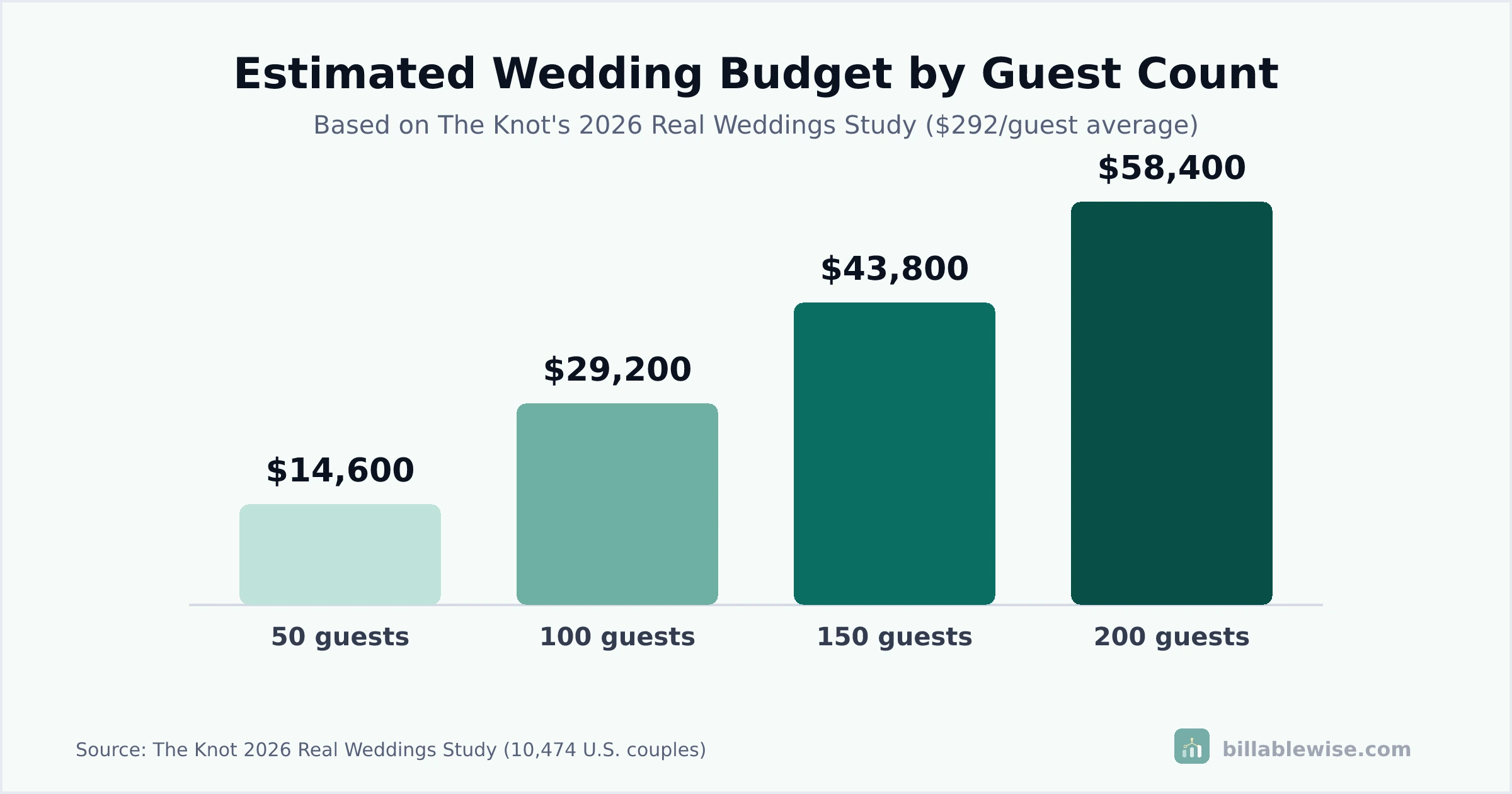
Catering, favors, rentals, and often venue capacity all scale directly with headcount. Cutting your guest list is usually the single most effective way to lower total cost, since it reduces several categories at once rather than just one.
The national average blends every U.S. region and every season together. A wedding in a major coastal city or during peak wedding season (typically late spring through early fall) commonly costs more than the same wedding in a lower cost-of-living area or an off-season month, even at the same guest count.
Categories like flowers, invitations, and decor have a wide cost range depending on whether you hire a professional for the full job or handle part of it yourselves. The category reference table's figures reflect couples who mostly hired out; doing more yourselves can bring individual line items down without changing your guest count at all.
If you are not sure where to start, use your guest count for the baseline estimate above, then adjust up for an expensive region or peak season, and down for doing more yourselves.
Every number below is computed by the same formula the calculator above uses.[1]
50 guests. Estimated total budget: $14,600. Estimated catering: $4,000.
100 guests. Estimated total budget: $29,200. Estimated catering: $8,000.
117 guests (the study's own average guest count). Estimated total budget: $34,164, close to the study's reported $34,200 average. Estimated catering: $9,360.
150 guests. Estimated total budget: $43,800. Estimated catering: $12,000.
200 guests. Estimated total budget: $58,400. Estimated catering: $16,000.
A budget estimate only helps if it changes how you book vendors. Here is how to put it to work.
Since guest count drives so much of the total, lock in a realistic guest list first, then run it through this calculator, rather than picking a budget number and hoping the guest list fits it later.
When a photographer or florist sends you a quote, compare it against the category reference table above. A quote running well above the national average is not automatically wrong, but it is worth asking what specifically justifies the difference before booking.
Set aside a separate amount for the engagement ring, rehearsal dinner, and honeymoon rather than folding them into your wedding-day number, since the source data itself keeps these separate and they often get planned and paid for on a different timeline.
Use the "Download as text" option once you have entered your guest count, so you have your estimate and the category reference table in one place to bring into vendor calls and planning documents.
A guest list commonly grows during planning. Re-run your guest count through the calculator whenever it changes meaningfully, rather than mentally adjusting an old estimate.
Most wedding budgets do not blow up because couples are careless. They blow up for a handful of predictable, fixable reasons.
Picking a round number first, then inviting everyone you want, almost always ends in the guest list outgrowing the budget. Set a realistic guest count first.
The engagement ring, rehearsal dinner, and honeymoon are separate costs that fall outside the wedding-day average. Couples who only budget the wedding day itself are routinely surprised by these later.
Region, season, and vendor choice can each push your actual total higher or lower than that. Use the average as a starting benchmark, then adjust for your specific situation rather than expecting to hit it exactly.
Putting wedding costs on a credit card or personal loan without a clear payoff plan adds interest cost on top of an already large one-time expense. Set a budget you can pay from savings, and adjust scope to fit it, rather than borrowing the gap. If an emergency comes up during planning, our Emergency Fund Calculator can help you keep that separate from wedding savings entirely, rather than raiding one to cover the other.
You do not have to choose between a smaller guest list and every other tradeoff. For most couples, a few specific choices move the number the most.
Since catering, favors, and often venue and rental costs all scale with headcount, trimming the guest list lowers several categories at once, more efficiently than trimming any single vendor category.
A weekday wedding or an off-season month commonly costs less for the same venue and vendors than a peak Saturday in late spring or early fall, since demand for those dates is highest.
Alcohol is one of the categories with the widest cost range. A beer-and-wine bar instead of a full open bar, or a shorter bar service window, meaningfully reduces that specific line item without changing the guest experience much.
Some venues and vendors offer a lower combined rate for booking catering, rentals, or photography and videography together rather than separately. Ask directly, bundled pricing is common but not always advertised upfront.
Invitations, favors, and some decor have a wide cost range specifically because some couples DIY them and others hire the work out fully. These are lower-risk categories to take on yourselves compared to catering or photography, where quality differences are harder to make up for later.
Multiply your expected guest count by the national average cost per guest, currently $292. This calculator does that automatically and also estimates your catering line item, the single largest guest-driven cost, using the same study's $80-per-guest catering average.
Guest count is the single biggest lever in a wedding budget, since catering, rentals, favors, and often venue capacity all scale with headcount. Multiply your guest count by $292 for a rough total, and by $80 for catering alone, both are real, published national averages, not estimates invented for this calculator.
The Knot's 2026 Real Weddings Study found U.S. couples spent an average of $34,200 on their wedding day in 2025, based on 10,474 real weddings.<Citation n={1} /> "Realistic" depends heavily on your own guest count and region: use this calculator's guest-count-based estimate as your own realistic starting point rather than the flat national average, which assumes the study's average guest count of 117.
The average total wedding cost was $34,200 in the most recent Real Weddings Study, for an average of 117 guests, working out to about $292 per guest.<Citation n={1} /> This figure covers the wedding day itself; it does not include the engagement ring, rehearsal dinner, or honeymoon, which the same study reports separately.
The Real Weddings Study reports an average catering cost of $80 per guest.<Citation n={1} /> For 100 guests, that is about $8,000. Catering is typically the largest or second-largest single line item in a wedding budget, alongside the venue.
This calculator deliberately does not offer a percentage breakdown that adds up to 100%, because the source data does not support one: the average cost of each category (venue, catering, photographer, and so on) comes from different subsets of couples who booked each item, not from one shared budget split into parts. Adding every category average together comes to roughly $53,000, well above the $34,200 total, proof that they are independent averages, not budget shares. Use the category reference table above as "what couples who booked this typically paid," not as percentages of your own total.
Not on this page, and deliberately so. Unlike housing, there is no official government guideline tying wedding spending to income the way there is for rent.<Citation n={2} /> The most consistent financial advice, regardless of income, is to avoid financing a wedding with high-interest debt and to set a guest-count-based budget you can pay for from savings.
The Real Weddings Study's reported average works out to $292 per guest ($34,200 total divided by an average of 117 guests).<Citation n={1} /> This is a blended average across every cost category, not just catering, and it tends to run higher per guest for smaller weddings, since fixed costs like the venue and photographer get spread across fewer people.
No. The Real Weddings Study reports the engagement ring ($4,600 average), rehearsal dinner ($2,800 average), and honeymoon ($5,500 average) as separate figures, additional to the $34,200 wedding-day total.<Citation n={1} /> Budget for these as their own line items, not as part of your wedding-day number.
The Real Weddings Study reports an average alcohol cost of $2,800.<Citation n={1} /> This varies enormously depending on whether you serve a full open bar, beer and wine only, or a cash bar, and on your guest count and local liquor costs.
Yes. This calculator is completely free, with no account, signup, or download required to use it, only to export your own results.
Yes. Once you enter your guest count, a "Download as text" button appears below your results, saving your estimate and the full category reference table to a plain text file you can keep or share.
This calculator is not a spreadsheet, but its download option gives you a plain text summary of your numbers that you can paste into your own spreadsheet or planning document as a starting point.
The national average figures here reflect typical U.S. weddings generally, not destination weddings specifically, which often carry different venue, catering, and travel costs. Use this as a rough starting benchmark for a destination wedding, then adjust for your specific location's pricing.
No, not accurately. This calculator is based on a U.S. survey of U.S. weddings, and costs, guest counts, and traditions for these celebrations differ substantially from that average, often with far larger guest counts and different category spending altogether. Treat this tool as a U.S.-market benchmark only, not a fit for these specific wedding traditions.
The dollar figures come from a U.S. survey, so they will not reflect real costs in Canada, the UK, or elsewhere. The underlying idea, that guest count is the main driver of total cost, still applies broadly, but the specific per-guest dollar amount will not match a different country's market.
It is only as accurate as a national average applied to your specific guest count. Region, season, venue type, and how much you do yourselves versus hire out can each shift your actual cost well above or below the average. Treat the result as a planning benchmark to sanity-check vendor quotes against, not a quote itself.
That is common, especially in expensive metro areas or for larger guest counts, and is not automatically a sign of overspending. Compare your actual vendor quotes against this calculator's category reference table to see which specific line items are running above average, then decide deliberately whether that tradeoff is worth it to you.
Financing a wedding with high-interest debt, such as credit cards or a personal loan, turns a one-day celebration into a multi-year cost, since you pay interest on top of the original amount for years afterward. Setting a guest-count-based budget you can cover from savings, and adjusting the guest list or scope to fit it, avoids that added cost entirely.