
3 Months
$0.00
Ramsey's target for a stable, dual-income household with no dependents. Also the Federal Reserve's own resilience benchmark.
Find out how much to save for emergencies. Enter your essential monthly expenses and this calculator shows your target across three benchmarks, 3, 6, and 8 months, so you can see exactly what each one means in dollars.
3 Months
$0.00
Ramsey's target for a stable, dual-income household with no dependents. Also the Federal Reserve's own resilience benchmark.
6 Months
$0.00
Ramsey's target for a single-income household or single parent, and a common general default.
8 Months
$0.00
Suze Orman's more conservative target, for extended job loss or reduced access to credit.
The 3-month benchmark reflects the Federal Reserve's own measure of household financial resilience, based on Federal Reserve: Economic Well-Being of U.S. Households in 2024 (SHED survey). The 6 and 8-month figures come from widely-used financial guidance, not government data.
Based on Federal Reserve: Economic Well-Being of U.S. Households in 2024 (SHED survey), not a guessed average.
"How much should I have saved for emergencies?" usually gets answered with a vague "3 to 6 months," with no explanation of where that range comes from or which end applies to you. This calculator uses three specific, named benchmarks instead of one blurry range, so you can see exactly what each one costs.
Enter your essential monthly expenses above, and the calculator multiplies that figure by 3, 6, and 8 to show all three targets at once. Add what you have already saved, and it also shows how many months that covers today and how much more each target needs.
Fifty-five percent of U.S. adults reported having enough savings to cover three months of expenses in 2024, up from 54% in 2023. That means close to half of adults have not reached even the lower end of the standard emergency fund range.[1]
This calculator produces a static savings target, it does not project investment growth or interest earned while you save, since an emergency fund belongs in a liquid, low-risk account, not invested for growth. It also does not include discretionary spending, only essential expenses, so your monthly budget will be larger than the figure this calculator uses.
| Figure | Value |
|---|---|
| Adults with 3-month savings, 2024 | 55% |
| Adults with 3-month savings, 2023 | 54% |
| Ramsey starter emergency fund | $1,000 |
| Ramsey fully funded target | 3-6 months |
Source: Federal Reserve: Economic Well-Being of U.S. Households in 2024 (SHED survey).
The calculator shows all three benchmarks at once, but most households only need to focus on one as their actual goal.
You have a stable job, a partner who also earns income, and no dependents relying solely on your paycheck. This is the leaner end of the standard range and the fastest realistic target to reach.
You are the sole income earner in your household, a single parent, or your income is less predictable than a typical salaried job. Six months gives meaningfully more runway if your one source of income is interrupted.
You want a more conservative cushion, work in an industry prone to layoffs, or are self-employed with irregular income. This is Suze Orman's more cautious target, built for a longer stretch without steady income.
If you are not sure, start with 3 months as your first milestone, and treat 6 or 8 months as where you keep building once that target is reached. Most households do not pick a target once and stay there forever, a change in job stability, income structure, or family size is a normal reason to move from one benchmark to another later.
Every number below is computed by the same formula the calculator above uses.
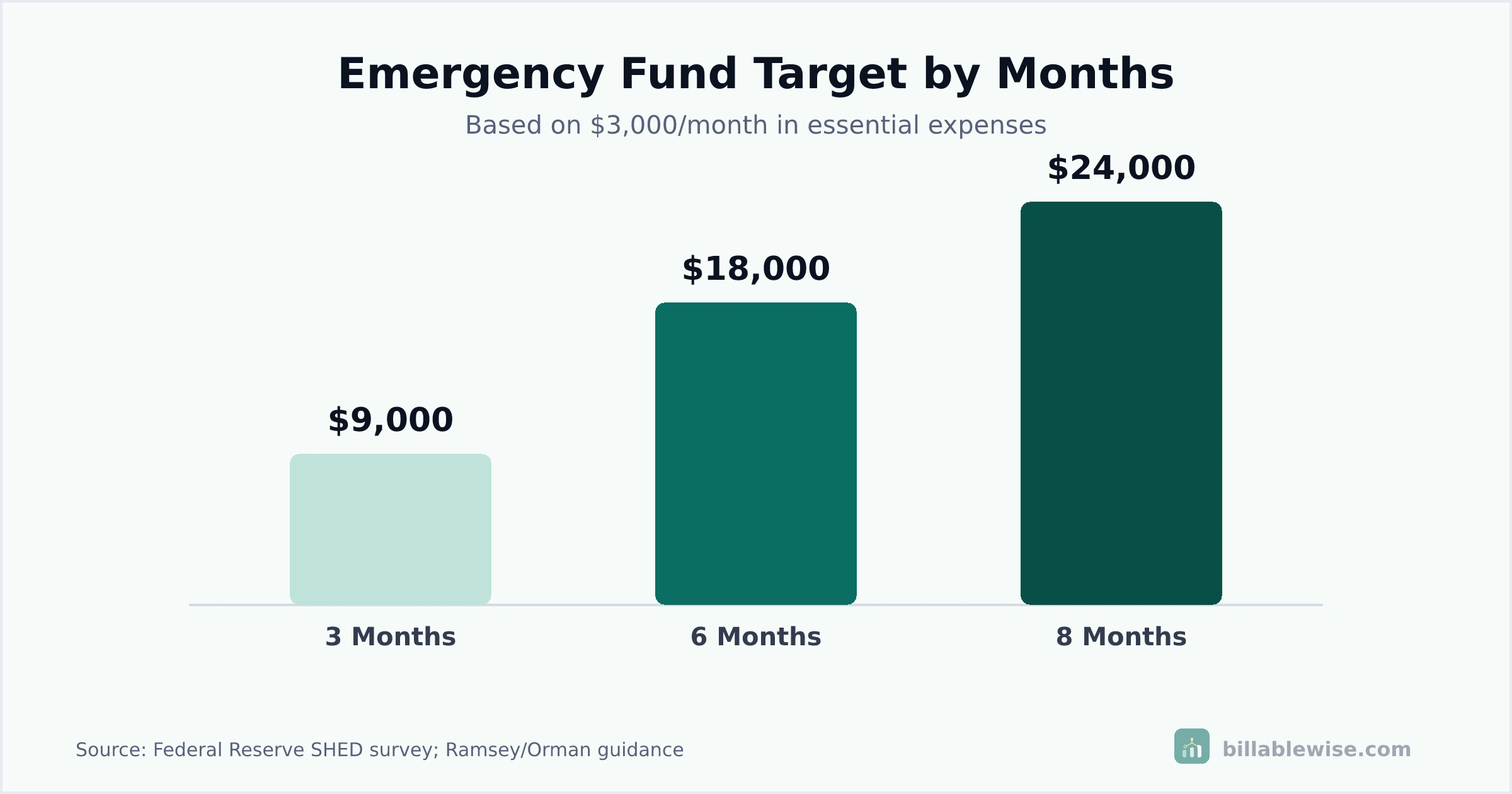
3 months: $9,000. 6 months: $18,000. 8 months: $24,000.
Current coverage: 2.0 months. 3-month target: $7,500 ($2,500 to go). 6-month: $15,000 ($10,000 to go). 8-month: $20,000 ($15,000 to go).
3 months: $13,500. 6 months: $27,000. 8 months: $36,000.
Current coverage: 2.9 months. 3-month target: $10,500 (only $500 to go). 6-month: $21,000 ($11,000 to go). 8-month: $28,000 ($18,000 to go).
3 months: $6,000. 6 months: $12,000. 8 months: $16,000.
A target number only helps if it changes how you save. Here is how to put it to work.
Ramsey's guidance is to build a smaller starter fund, historically $1,000, quickly first, before tackling debt or the full 3-6 month target.[2] A smaller first milestone is faster to reach and keeps a minor emergency from turning into new debt while you work toward the bigger number.
Set up an automatic transfer to a separate savings account on payday, before you have a chance to spend the money elsewhere. A smaller, consistent automatic amount usually beats a larger amount you have to remember to move manually.
A dedicated savings account, ideally at a different bank than your everyday checking, adds enough friction that you will not casually dip into it for non-emergencies, while still keeping it accessible within a day or two when you need it.
A new dependent, a rent increase, or a new recurring bill all raise your target. Re-run the numbers whenever your essential monthly expenses change meaningfully, rather than assuming an old target still applies.
Once you hit your target, extra savings can go toward other goals, you do not need to keep growing the emergency fund indefinitely. Redirecting new savings elsewhere once you are fully funded is a normal way to keep saving toward other goals.
Most people who fall short of an emergency fund are not being careless. A handful of specific, avoidable mistakes explain most of the gap.
A high earner with high discretionary spending needs a smaller emergency fund than their income alone would suggest, since only the essential expenses need covering during an emergency. Expenses are the base number, since they reflect what must be covered if income stops.
Putting emergency savings into stocks or other volatile investments risks needing the money exactly when the market is down, the worst possible time to sell. Keep this specific money liquid and stable, even though it means giving up potential investment returns on it.
Ramsey's $1,000 starter fund is a first milestone.[2] Stopping there leaves a household exposed to anything larger than a minor emergency; the full 3, 6, or 8-month figure is the target to reach.
A target calculated years ago, before a move, a new child, or a change in income, can become outdated without you noticing. An emergency fund sized for an old version of your life may fall short when you need it.
An annual insurance premium, a holiday season, or a known upcoming repair are predictable costs that deserve their own separate savings line. Pulling from the emergency fund for these leaves less available for an unplanned event and defeats the purpose of keeping the two separate. A large planned expense like a wedding is the clearest example, our Wedding Budget Calculator can help you size that savings goal on its own, rather than borrowing against this one.
You do not need a dramatically higher income to reach your target faster. For most households, a few specific habits move the number more than anything else.
A tax refund, bonus, or cash gift is an easy way to make a large jump toward your target without changing your monthly budget at all. Committing in advance to saving a set share of any windfall keeps this from becoming a one-time decision you have to relitigate each time.
If you are aggressively paying down low-interest debt beyond the minimum, temporarily redirecting that extra amount toward your starter emergency fund, then resuming afterward, is a common and reasonable sequencing choice, consistent with Ramsey's own ordering of steps.[2]
Once you know your rent and grocery numbers from our Rent Budget Calculator and Grocery Budget Calculator, comparing them against what you actually spend often reveals room to redirect toward your emergency fund without a major lifestyle change. If you split rent with roommates, our Rent Split Calculator can also help confirm your own share is not larger than it needs to be.
A high-yield savings account keeps your emergency fund liquid while still earning meaningfully more than a typical checking account, without exposing the money to investment risk. The extra yield will not replace consistent saving, but it is a no-effort boost once the account is set up.
Watching your progress in "months covered" rather than a raw dollar figure keeps the number meaningful even if your expenses change, and makes it easier to see exactly how close you are to your chosen target.
Canceling a single underused subscription or renegotiating one recurring bill often frees up more monthly savings, with less ongoing effort, than trying to trim a dozen small discretionary purchases at once. One meaningful cut sustained every month compounds faster than several small ones abandoned after a few weeks.
Multiply your essential monthly expenses (rent, food, utilities, insurance, minimum debt payments) by the number of months you want covered, commonly 3, 6, or 8. This calculator does that multiplication for all three benchmarks at once, so you can compare them side by side.
It depends on your situation, but three named benchmarks cover most cases: 3 months for a stable, dual-income household with no dependents, 6 months for a single-income household or single parent, and 8 months for a more conservative cushion against extended job loss.[2] There is no single number that fits everyone.
Add up your essential monthly expenses, then multiply by 3 for the lower end and by 6 for the upper end of the range. Dave Ramsey's own guidance splits this further: 3 months if you have a stable, dual income with no dependents, 6 months if you have a single income or are a single parent.[2] This calculator shows both figures at once.
Ramsey's Baby Step 1 is a $1,000 starter emergency fund, meant to be built quickly before anything else. Baby Step 3, after paying off non-mortgage debt, is a fully funded emergency fund of 3-6 months of expenses.[2] This calculator's 3 and 6-month figures reflect that guidance directly.
Suze Orman has publicly recommended a more conservative 8-month emergency fund, citing reduced access to credit and the possibility of extended job loss. This calculator includes an 8-month figure for exactly this more cautious approach.
Use essential, non-discretionary expenses only: housing, food, utilities, insurance, transportation, and minimum debt payments. Leave out discretionary spending like entertainment, dining out, or subscriptions, since the point of the fund is to cover what you truly cannot skip if income stops.
Divide your current emergency savings by your essential monthly expenses. The result is your emergency fund ratio expressed in months, for example $9,000 in savings against $3,000 in monthly expenses is a ratio of 3 months. Enter both figures above and this calculator shows that ratio automatically.
In Ramsey's terminology, it is the 3-6 month target reached after clearing non-mortgage debt, distinct from the smaller $1,000 starter fund meant only to cover a small emergency while you focus on debt.[2] "Fully funded" means the full months-of-expenses target has been reached.
Most financial guidance points toward the higher end of the range, or beyond it, for irregular income. Without a predictable paycheck, a temporary slow period is harder to distinguish from an emergency, so many self-employed workers target 6-12 months instead of the 3-6 month range built for stable employees.
This calculator does not estimate a timeline, since that depends entirely on how much you can save each month. Divide your target amount by whatever you can realistically set aside monthly to get a rough number of months, and treat Ramsey's $1,000 starter fund as a faster first milestone before the full target.[2]
Inflation has eroded that fixed dollar figure's buying power since Ramsey set it, so $1,000 does not stretch as far as it used to. Ramsey's own framing treats it as a fast, motivating first milestone toward the 3-6 month fully funded amount that follows it.[2] Some households now use a larger starter figure, like $2,000, before starting the full fund.
In a liquid, low-risk account you can access quickly without penalty, typically a high-yield savings account. Emergency funds are not meant to be invested in the stock market or tied up in accounts with withdrawal penalties, since the whole point is being able to reach the money fast when something goes wrong.
Yes. This calculator is completely free, with no account, signup, or download required.
According to the Federal Reserve's own household survey, 55% of U.S. adults reported having enough savings to cover three months of expenses in 2024, up slightly from 54% in 2023.[1] That means close to half of adults fall short of even the lower end of the standard 3-6 month range.
The calculation itself, months of expenses times a target number of months, works with any currency. The specific U.S. savings-rate statistic cited on this page comes from the Federal Reserve and reflects U.S. households only, so treat the percentage context as U.S.-specific even though the math applies anywhere.
An emergency fund is a savings account with a specific purpose: covering essential expenses during a job loss, medical issue, or unplanned major cost. A general savings account might be earmarked for anything, a vacation, a purchase, no particular goal, which makes it easy to accidentally spend down the exact money you were counting on for an emergency.
Base it on expenses, not income. Your expenses are what you need to cover if income stops; using income instead risks overshooting your target if you save aggressively, or undershooting it if a large share of your income goes to non-essential spending.
This calculator serves the same core purpose, turning your expenses into a savings target, using the same widely-cited benchmarks (3, 6, and 8 months) that most calculators in this space reference. It additionally shows your current progress in months covered if you enter what you have already saved, and lets you share your exact result with a link.
A common approach, including Ramsey's baby-step ordering, is a small starter fund first (enough to avoid new debt from a minor emergency), then focused debt payoff, then the full 3-6 month fund once debt is cleared.[2] Building the full fund before touching debt, or ignoring the starter fund and going straight to debt, both leave you exposed to a small emergency turning into new debt.
This calculator does the same core math a spreadsheet formula would, essential expenses multiplied by months, instantly and without setup. If you want to track your progress over time in your own file, copy this calculator's target numbers into a spreadsheet and update your actual savings balance as you go.
Job loss, a major medical bill, an urgent home or car repair, or another unplanned essential cost are the classic uses. A predictable annual expense, like an insurance premium or holiday spending, is not an emergency, budget for those separately instead of pulling from this fund.
This is exactly the situation Ramsey's 6-month target is built for.[2] With no second income to fall back on and people depending on that income, a longer runway matters more than it would for a dual-income household with no dependents, since replacing lost income realistically takes longer to arrange.