
Roommate 1
$0.00
50.0% of rent
Split rent fairly between roommates in seconds. Enter your total rent, pick equal, income-based, or room-size-based splitting, and see exactly what each person owes, with the math shown so nobody has to take it on faith.
Everyone pays the same amount, regardless of income or room size.
Roommate 1
$0.00
50.0% of rent
Roommate 2
$0.00
50.0% of rent
Equal and income splits divide the total proportionally with no external data needed. The square-footage method uses each person's private room size; if your apartment has a lot of shared common space, consider giving smaller-room roommates a bit of credit for that when agreeing on final numbers.
Splitting rent evenly is easy. Splitting it fairly, when rooms or incomes are not equal, is where most roommate arguments start. This calculator does not need to look up any external data, since it is straightforward arithmetic applied to numbers you already know: your rent, and either nothing extra, everyone's income, or everyone's room size.
Add roommates with the "Add another roommate" button (up to 8), remove with "Remove" (down to 2), and every share recalculates instantly as you type.
There is no single "correct" way to split rent. The right method is whichever one your household agrees reflects what you actually value, equal contribution, ability to pay, or private space received.
If you have used or heard of the New York Times' rent-splitting calculator, it is worth knowing it uses a different, more advanced approach: an iterative "envy-free" algorithm related to Sperner's Lemma from fair-division mathematics, which asks each roommate their room preference at different price points rather than applying income or square footage directly.[2] This calculator uses the simpler, direct proportional methods most people are actually searching for: split evenly, by income, or by room size, none of which need a back-and-forth negotiation step.
Every method's percentages always add up to exactly 100% of your entered rent, since each is a direct proportional division, not an estimate.
All three methods are one click away in the calculator above. Use the breakdown below to decide which one fits your household.
| Method | Best for |
|---|---|
| Equal split | Similar rooms, similar incomes, or couples sharing finances jointly |
| By income | Uneven incomes, roommates who keep finances separate |
| By room size | Rooms that differ noticeably in size or features |
Your rooms are similar in size, your incomes are in a similar range, or you are a couple who shares finances jointly. Equal split is the simplest to agree on and the easiest to explain to a new roommate later.
Incomes in the household differ meaningfully and everyone wants payment tied to ability to pay rather than to the specific room. This is common among roommates, less common among couples who pool money.
One or more rooms are noticeably bigger, have better features like an en-suite bathroom or more closet space, and the household wants payment tied to what each person actually gets, not to income.
If you are not sure, start with equal split as the default, and switch to income or room size only if someone in the household specifically feels it is unfair, rather than overengineering the split before anyone has a complaint. Most households that switch away from equal split do so once, early on, rather than repeatedly changing methods, so getting the conversation right the first time saves you from redoing it later.
Every number below is computed by the same formula the calculator above uses.
$1,800 total rent, 2 roommates, equal split. Each pays $900.00.
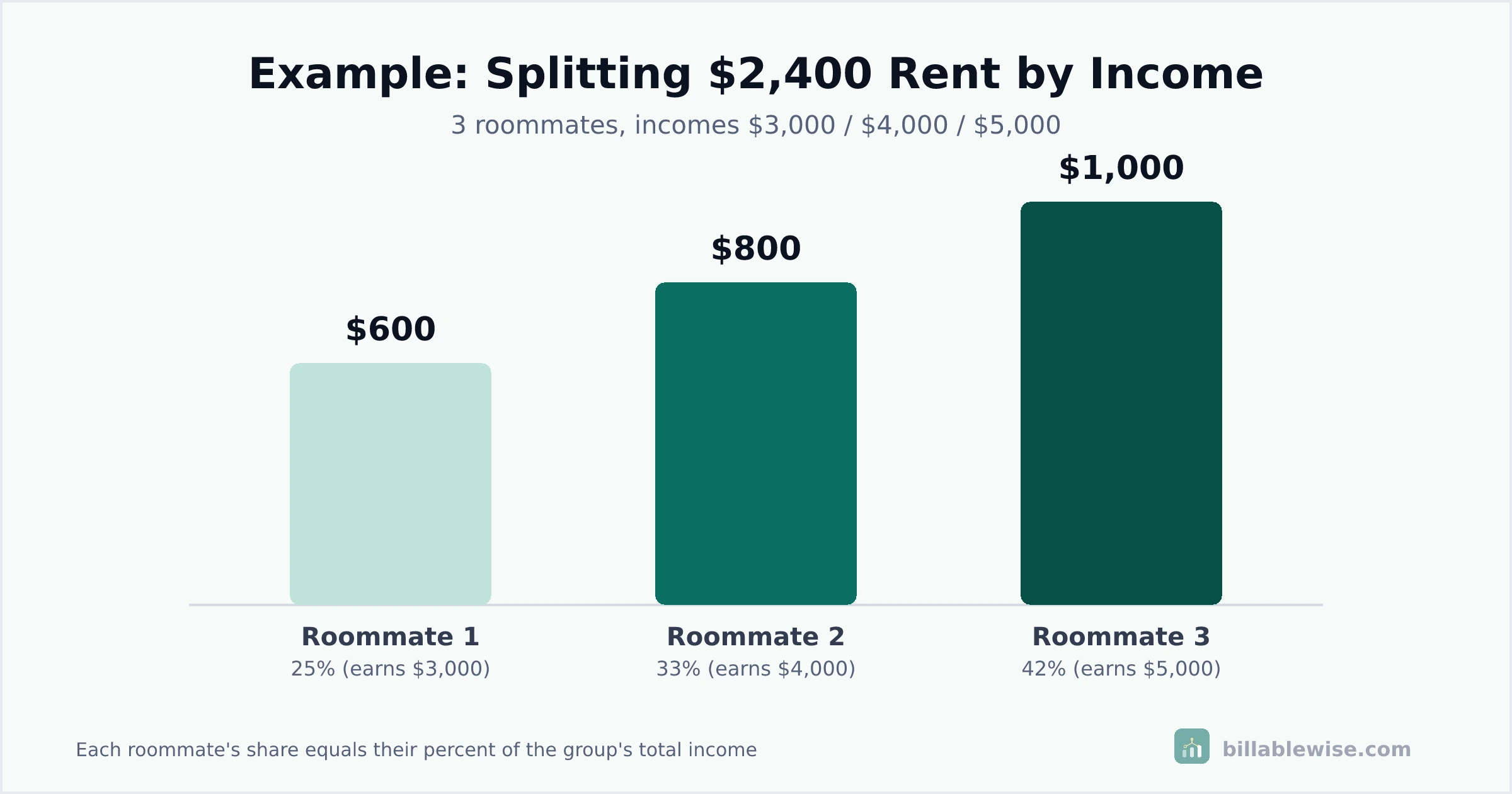
$2,400 total rent, incomes $3,000 / $4,000 / $5,000. Shares: $600.00 / $800.00 / $1,000.00 (25% / 33.3% / 41.7%).
$2,000 total rent, rooms 120 sq ft and 180 sq ft. Shares: $800.00 / $1,200.00 (40% / 60%).
$3,200 total rent, 4 roommates, equal split. Each pays $800.00.
$2,200 total rent, incomes $4,500 and $5,500. Shares: $990.00 / $1,210.00 (45% / 55%).
A rent split only works if everyone actually agrees to it before move-in, not after the first disagreement. The steps below turn the calculated numbers into an agreement the whole household has signed off on.
Decide as a household whether you are splitting equally, by income, or by room size before running any numbers, not after seeing which method benefits you personally. Picking the method first keeps the conversation about fairness, not about a specific dollar figure.
If you use the income method, that means being open about income with roommates, which not everyone is comfortable with. Agree upfront whether the household is willing to do that; if not, room-size or equal split avoid the issue entirely.
A shared document or a message thread with the final dollar amounts, dated, avoids disputes later about what was actually agreed. Use the share link from this calculator to send roommates the exact numbers you calculated together.
A roommate moving out, a new roommate moving in, or a significant income change are all reasons to recalculate, rather than informally adjusting an old agreement. A roommate leaving unexpectedly or falling behind on their share is also a real risk, since covering someone else's rent for even a month can strain the rest of the household; our Emergency Fund Calculator can help you size a personal cushion for exactly that gap.
Utilities, internet, and shared supplies often get split differently than rent itself, commonly equally regardless of room size or income. Keep that as a separate conversation and a separate number from the rent split.
Once you know your individual share, check it against the same federal housing affordability standard used for a solo rent number: a household is considered "cost burdened" above 30% of gross income.[1] Our Rent Budget Calculator applies that standard directly to your own income, so you can see whether your share of this split fits comfortably or stretches your budget.
Most roommate rent disputes trace back to a handful of avoidable mistakes, not bad faith.
Defaulting to equal split by habit, without ever discussing whether room size or income should matter, is how resentment builds over time. A five-minute conversation before move-in prevents most of this.
If one room is meaningfully bigger or better, addressing it upfront with a room-size split is easier than renegotiating after months of an equal split that one roommate has resented.
Splitting rent by room size but utilities by income, without both roommates explicitly agreeing to that combination, tends to feel arbitrary to whoever comes out worse on either one. Agree on the logic for each shared cost separately, out loud.
An old rent split, based on rooms or incomes that no longer reflect reality, gradually becomes unfair over time. Re-run the numbers whenever the household or anyone's income changes meaningfully.
Fairness looks different to different people, one roommate might weigh room size heavily while another cares more about income parity. Asking each person what factors matter to them, instead of assuming everyone shares your view of fairness, avoids a split that looks reasonable on paper but leaves someone unhappy without saying so.
Real apartments rarely have identical rooms and identical incomes. Here is how households commonly handle the gaps this calculator's three clean methods don't fully cover on their own.
A room with its own bathroom is worth more than its square footage alone suggests to most people. Many households add a flat monthly premium, for example an extra $50 to $100, on top of whatever the room-size calculation gives that room, then split the remaining rent by size as usual.
To avoid one high earner covering an extreme share, some households pay a smaller equal amount first, then split only the remaining rent by income. Calculate the equal portion yourselves, subtract it from total rent, then run only the remainder through this calculator's income method.
Room-size splitting compares private room sizes, not the whole apartment. If common space (kitchen, living room) is unusually large or small relative to the bedrooms, some households add a small equal-split premium for common space on top of the room-size result, since everyone benefits from it equally regardless of bedroom size.
A bedroom next to a noisy street, with no closet, or with less natural light is a common source of "the numbers say fair but it doesn't feel fair." A manual discount, agreed on by the household, is a normal and reasonable adjustment on top of any of these three methods.
Whatever adjustment you make on top of the calculator's numbers, agree on the exact dollar amount and the specific reason for it, in writing, so it doesn't turn into a point of confusion at the next lease renewal.
Pick a method: split the rent evenly, by income, or by room size. Enter your total rent and each roommate's income or room size (not needed for an equal split), and this calculator divides the total automatically using whichever method you pick.
Add up everyone's monthly income, then give each person a share of the rent equal to their share of that total income. For example, if one roommate earns 25% of the household's combined income, they pay 25% of the rent. This calculator does that division for you.
Add up everyone's private room square footage, then give each person a share of the rent equal to their share of that total square footage. A roommate with a room that is 40% of the combined room space pays 40% of the rent under this method.
There is no single official "fair" method, it depends on what your household values. Equal split treats everyone's use of shared space the same regardless of room or income. Income-based split ties payment to ability to pay. Square-footage split ties payment to private space received. Pick the method that matches what your household actually cares about.
For two people sharing one space, equal split is the most common approach if you share the space and finances jointly. If you keep finances separate and want payment proportional to what each of you earns, use the income-based method instead with just two roommates entered.
A one-bedroom split three ways usually means one or two people are in non-bedroom or shared spaces, which square-footage splitting was not designed for. In that case, equal split or an income-based split are more practical than trying to measure private space, since the space itself is not divided into three comparable private rooms.
The New York Times built a well-known interactive tool based on fair-division research related to Sperner's Lemma.<Citation n={2} /> Instead of a fixed formula, it asks each roommate for their own room preference at different price points and searches for a "envy-free" outcome where nobody would rather trade their room and price for someone else's. This calculator does not attempt to replicate that interactive process, it uses simpler, direct proportional methods, splitting evenly, by income, or by room size, that do not require an iterative negotiation.
Equal split is simpler and works well when incomes are similar or when the household treats finances jointly. Income-based split makes more sense when incomes differ significantly and the household wants payment to scale with ability to pay, common among roommates who are not couples and keep finances separate.
Use square footage when private room size is the main source of unfairness, for example one bedroom is noticeably larger or has an en-suite bathroom. If all rooms are similar in size, square-footage splitting will produce a result close to equal split anyway, so it mainly matters when the rooms differ enough to notice.
Square-footage splitting directly accounts for this: a bigger private room means a proportionally bigger share of rent. Many households also add a flat premium for a room with its own bathroom or a private entrance on top of the square-footage split, this calculator does not automate that adjustment, add it manually to the larger room's number if your household wants it.
Measure each private bedroom's square footage, enter total rent and each room's size using the square-footage method, and the calculator gives each roommate a proportional share. If all three rooms are close in size, consider equal split instead, since the difference in outcome will be small.
Yes. This calculator is completely free, with no account, signup, or download required.
Not automatically. If parking is billed separately or one roommate gets a dedicated spot, calculate the base rent split first with this calculator, then add the parking cost to whichever roommate's total should include it, rather than folding it into the room-size or income calculation.
"Proportional" usually means income-based or square-footage-based, both divide the total in proportion to a number (income or room size) rather than splitting it evenly. Pick whichever number your household wants to base fairness on, and this calculator handles the proportional math.
It reflects ability to pay, which many households consider more fair than an equal split when incomes differ significantly. Some households instead use a hybrid: a smaller equal base amount everyone pays, then split the remainder by income, to avoid one high earner covering an extreme share. This calculator does not include that hybrid mode directly, but you can approximate it by first splitting a portion of the rent equally yourselves, then running only the remainder through the income method.
Yes, the same methods apply regardless of whether you are students or working professionals. For students without steady income, equal split or square-footage split are usually more practical than income-based split.
Yes, the math is not U.S.-specific, splitting evenly, by income, or by room size all work with any currency and any country's room sizes. Just enter your rent and figures in whatever currency you use; the calculator does not convert or label currency, so keep your own inputs consistent.
This calculator is not NYC-specific, but you can apply the same evenly, income-based, or room-size-based approach directly to any NYC apartment. Small NYC apartments and unconventional room configurations, like a "flex" or converted living room used as a bedroom, are exactly the kind of case where square-footage splitting is most useful.
Yes, use the "Add another roommate" button to add up to 8 total, or remove down to 2. Every roommate's share recalculates automatically whenever you add, remove, or change anyone's numbers.
Multiply your normal monthly share by the number of days you will actually occupy the unit that month, divided by the total days in that month. For example, if your usual share is $900 and you move in on the 16th of a 30-day month, you owe $900 times 15 divided by 30, or $450, for that first partial month, then your full share afterward.
Not automatically. A flex room, often a converted living room or den used as a bedroom, usually has less privacy and sometimes no closet or window meeting a legal bedroom's requirements. Many households discount a flex room by roughly 10-20% below what its raw square footage alone would suggest, then split the rest of the rent using the square-footage method for the remaining rooms.
A basic calculator usually only offers an equal split. A detailed one, like this calculator, adds income-based and room-size-based methods and shows each person's exact percentage alongside their dollar amount, so the household can see the reasoning, not just a final number to take on faith.