
Thrifty Plan
$611.82 /month
$141.20 /week
USDA's lowest-cost plan. Used to set maximum SNAP benefits.
Budgeting
Data last verified: September 2026 · Built by Muhammad Ayaz Akhtar
Work out a realistic monthly grocery budget for your household. Enter how many people you are feeding by age group and get a benchmark across four official USDA spending tiers, from Thrifty to Liberal, built on official government data instead of a rule-of-thumb guess.
Household size: 2 (+10% household-size adjustment)
Thrifty Plan
$611.82 /month
$141.20 /week
USDA's lowest-cost plan. Used to set maximum SNAP benefits.
Low-Cost Plan
$627.55 /month
$144.83 /week
A modest step up from Thrifty, still budget-focused.
Moderate-Cost Plan
$774.73 /month
$178.80 /week
USDA's benchmark for a typical, varied U.S. diet.
Liberal Plan
$963.49 /month
$222.36 /week
USDA's highest tier: more variety, seafood, and out-of-season produce.
Based on the USDA Food Plans, U.S. Average, January 2025, USDA's official cost-of-food-at-home estimates. USDA updates these figures monthly for food-price inflation, so treat this as a starting benchmark, not an exact prediction of your local prices.
Based on USDA Food Plans, U.S. Average, January 2025, not a guessed average.
Most grocery budget advice is a guess dressed up as a rule of thumb: "spend 10% of your income," "budget $200 per adult," and similar rules that ignore your household's actual age mix and size. This calculator uses an official benchmark instead: the USDA Food Plans, published monthly by the U.S. Department of Agriculture as the official cost of a nutritious diet, prepared and eaten at home, at four spending levels.[1]
All four plans describe the same underlying nutrition. What changes between them is food choice and variety.
The Thrifty Food Plan is the same plan the federal government uses to set the maximum SNAP benefit a household can receive. That means it has to reflect a purchasable grocery list, priced and checked like any other federal benefit calculation.[2]
That is also why USDA's figures hold up better than most rule-of-thumb budgeting advice. A plan used to set federal benefit levels gets checked and updated against grocery prices every month. A flat percentage-of-income rule gets written once and left to go stale.
USDA publishes a separate monthly food cost for each age and sex group, since a teenage boy and a retired woman need very different amounts of food energy. This calculator sums the right per-person figure for everyone in your household, then applies USDA's own household-size adjustment shown below.[1]
| Household size | Adjustment to summed cost |
|---|---|
| 1 person | +20% |
| 2 people | +10% |
| 3 people | +5% |
| 4 people | No change |
| 5-6 people | -5% |
| 7 or more people | -10% |
Smaller households do not get a lower food bill per person, they get a higher one, because fixed costs like spices, condiments, and small package sizes get spread across fewer people. Larger households save a little per person for the opposite reason.
This calculator estimates food and beverages prepared and eaten at home, nothing else. It does not include alcohol, tobacco, vitamins, pet food, paper goods, or restaurant meals. It also does not account for special diets that require costlier ingredients: certain allergy-friendly, medically prescribed, or specialty diets can run well above even the Liberal tier. Treat the result as a starting benchmark, then adjust for anything specific to your household, and expect your bill to sit a little above the estimate if you regularly buy any of the categories left out above.
The calculator gives you all four numbers at once, but most households only need one of them for day-to-day budgeting. Here is a simple way to pick.
You are working with a tight, fixed food budget, you already meal-plan carefully, and you are comfortable buying store-brand staples and cooking almost everything from scratch. This is also the plan that lines up with SNAP benefit levels, so it is a natural fit if you are budgeting around SNAP.[2]
You want discipline without the tightest possible number. This is where most households land once they start actively trying to save on groceries.
You shop fairly normally: some name brands, some convenience items, occasional treats, with no specific effort to cut costs. USDA designs this tier as its benchmark for a typical American diet, which makes it the most realistic starting point for most households comparing their actual spending to a benchmark for the first time.[3]
Your household regularly buys higher-cost proteins like seafood, prioritizes fresh and out-of-season produce, or has more time and interest in varied home cooking. This tier reflects pricier food choices while keeping the same underlying nutrition as every other tier.
If you are not sure which applies, start with Moderate-Cost, track your spending against it for a few weeks, and move up or down a tier based on what you see.
Every number below is computed by the same formula the calculator above uses, U.S. average figures.[2][3]
One woman, age 19-50, Moderate-Cost plan. Household size 1 applies a +20% adjustment. Result: $386.52/month ($89.20/week).
One woman and one man, both 19-50, Low-Cost plan. Household size 2 applies a +10% adjustment. Result: $627.55/month ($144.83/week).
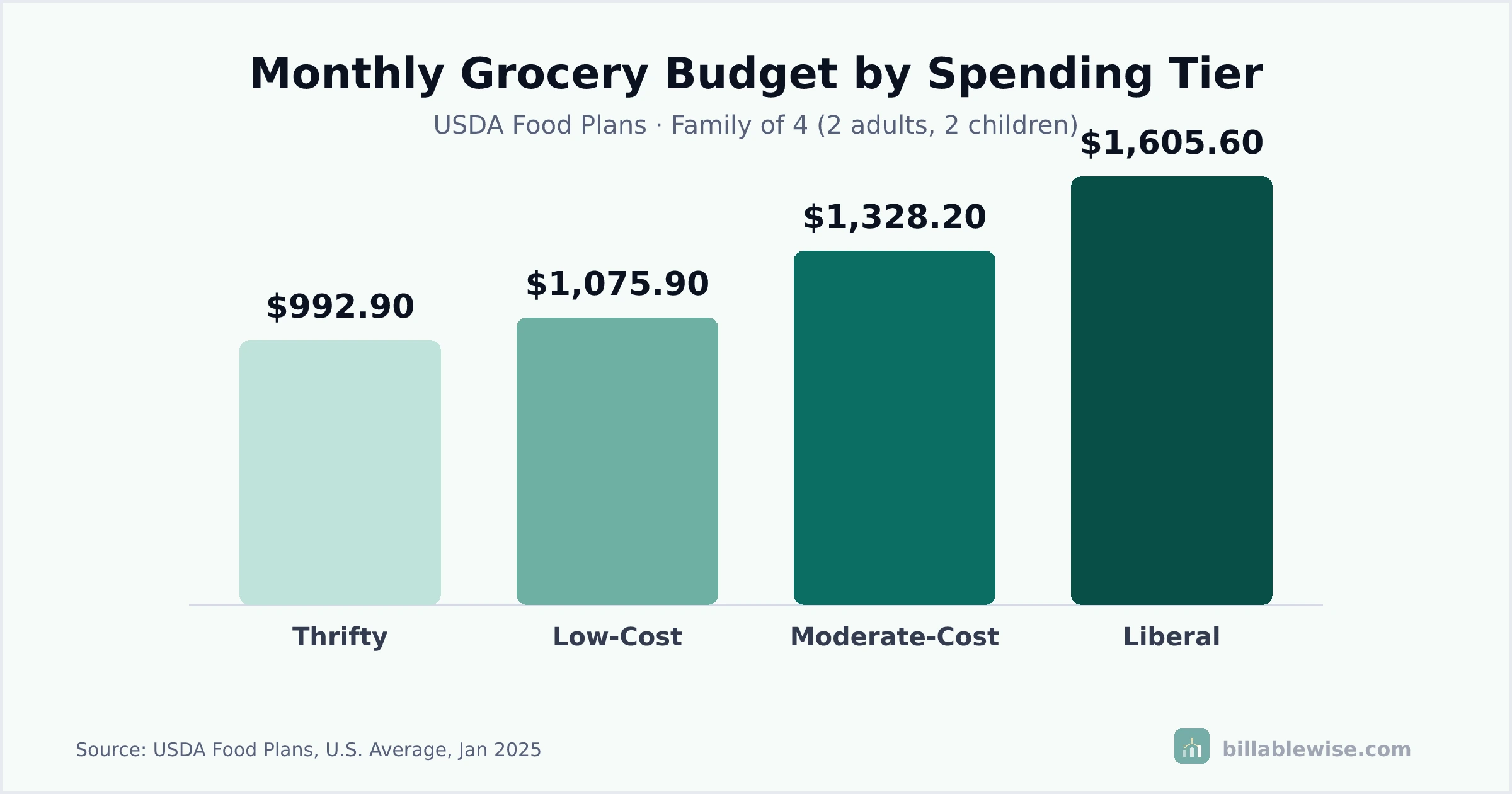
Two adults (19-50) and two kids (6-11). No household-size adjustment at size 4. Thrifty $992.90/month[2], Low-Cost $1,075.90/month, Liberal $1,605.60/month[3]. Moderate-Cost result: $1,328.20/month ($306.53/week).
Two adults (19-50), one teen girl (12-18), and two kids (6-11), Moderate-Cost plan. Household size 5 applies a -5% adjustment. Result: $1,554.30/month ($358.71/week).
One woman, age 51+, Thrifty plan. Household size 1 applies a +20% adjustment. Result: $276.48/month ($63.81/week).
A benchmark only helps if it changes what you buy. Once you have a monthly or weekly figure from the calculator above, here is how to put it to work.
Divide your monthly figure by 4.3, the average number of weeks in a month, instead of 4. It is a small correction, but a flat "divide by 4" overspends by roughly a week's worth of groceries every few months.
Build your list from a rough meal plan for the week instead of what looks good in the aisle. This is the single biggest lever for staying under budget: unplanned items are what push a shop past its limit.
Two packages of the same item can have very different prices per ounce or per unit even when the sticker price looks similar. Most stores print the unit price on the shelf tag in small type below the price. Check it before defaulting to the biggest or most familiar package.
Waiting until the end of the month to check your spending means you find out you are over budget only after it is too late to fix it. Keep receipts or check your card statement weekly, and compare the running total to your weekly figure from the calculator. A quick five-minute check every Sunday catches an overspend early enough to correct course before the next shop.
Fruit and vegetables cost noticeably less when they are in season locally, sometimes well below the price of the same item shipped in off-season. Rotating your produce list with the season, rather than buying the exact same items year-round, is one of the easier ways to hold a Moderate-Cost or Liberal tier budget without it feeling like a cutback.
Add items to a shared list on your phone or on the fridge the moment you notice you are low, instead of trying to remember everything at the store. Households that shop from a memory-based list tend to either forget items and make a second, more expensive trip, or overbuy out of caution.
Groceries are usually the second-biggest line item in a monthly budget after housing. If you have not worked out that number yet, our Rent Budget Calculator can help you get there first.
Most households do not overspend because they eat expensive food. They overspend for a handful of predictable, fixable reasons.
If you eat out for lunch three times a week, cook mostly from scratch, and rarely buy pre-cut produce, the Thrifty or Low-Cost tier is unrealistic no matter how disciplined you are. Pick the tier that matches your actual habits first, then work down from there if you want to spend less.
USDA's figures are a U.S. average. Grocery prices in a major coastal city can run well above that average, and prices in a lower cost-of-living region can run well below it. If your bill consistently misses the benchmark by a wide, stable margin, local prices are the likely explanation.
Food prices move with inflation, and so does your household. A number that was accurate a year ago is not automatically accurate now. Re-check your budget periodically instead of treating one calculation as permanent.
A grocery budget calculator gives you a target, not a guarantee. If your spending is consistently above your number, the useful next step is figuring out where the gap is coming from, eating out, food waste, or an unrealistic tier, then adjusting instead of abandoning the budget.
Grocery prices also move with inflation and the occasional bad month, a temporary spike that a stable monthly budget alone will not absorb. Our Emergency Fund Calculator can help you size a cash cushion for exactly that kind of month, separate from your regular grocery budget.
You do not need to move from Moderate-Cost to Thrifty to spend less. For most households, the easiest savings come from cutting waste and overlap rather than buying cheaper food.
Food that gets thrown out uneaten is money spent for nothing. Planning meals around what you already have before buying more, and freezing portions you will not eat in time, recovers budget without changing your grocery list at all.
Cooking a large batch of a base ingredient, rice, beans, a roasted protein, once and building several different meals from it uses less total food, less packaging, and less of your time than cooking a completely different meal every night.
Store-brand groceries are typically noticeably cheaper than the equivalent name-brand product, with no real difference in the food inside for most staples like flour, canned tomatoes, or frozen vegetables. Save name-brand spending for the handful of items where your household notices the difference.
Rice, pasta, canned goods, and frozen vegetables keep for months. Buying extra when they are discounted, and less when they are not, smooths out your average cost without changing what you eat week to week.
This calculator only estimates food prepared and eaten at home. If your household eats out often, expect your actual grocery spending to land under the benchmark, since the gap simply reflects meals eaten away from home.
A new baby, a teenager who suddenly eats twice as much, or a household member moving out all change your number. Re-run the calculator whenever your household composition changes rather than mentally adjusting an old figure.
Enter how many people are in your household by age group (young children, kids, teens, adult women and men, and seniors). The calculator sums the USDA per-person food cost for each group, then applies USDA's household-size adjustment to get your total monthly and weekly grocery budget across four spending tiers. You do not need to do any math yourself; the calculator handles the summing and the adjustment automatically.
Add up the USDA monthly cost for every person in your household at the spending tier you want (Thrifty, Low-Cost, Moderate-Cost, or Liberal), then apply the household-size adjustment: add 20% for a 1-person household, 10% for 2 people, 5% for 3 people, no change for 4 people, subtract 5% for 5-6 people, or subtract 10% for 7 or more people.
Start from an authoritative benchmark instead of guessing. USDA publishes four official spending tiers for exactly this purpose. Pick the tier that matches how you shop today (Thrifty for the tightest budget, Liberal for the most variety), then adjust up or down from there based on dietary needs, food waste, or how much you eat out.
This calculator works in any browser, on desktop or mobile, with no app or account needed. Bookmark this page to come back to it, or add it to your phone's home screen for quick access before you shop.
For a reference family of two adults (19-50) and two children (6-8 and 9-11), USDA's U.S. average figures are about $993/month on the Thrifty plan, $1,076/month on Low-Cost, $1,328/month on Moderate-Cost, and $1,606/month on Liberal [2][3]. Enter your own household above for a number matched to your exact ages and household size.
It depends heavily on age. USDA's Moderate-Cost plan estimates about $196/month for a young child (1-5), $312/month for a kid (6-11), and $322-$382/month for an adult, since teenage boys and adult men have the highest food-energy needs and adult women and seniors typically cost less [3]. There is no single "per person" number that works for every household, which is why this calculator asks for ages instead of just a headcount.
No. USDA's Food Plans cover food and beverages only, prepared and eaten at home. Paper towels, cleaning products, and other non-food grocery items are not included, so budget for those separately.
Smaller households pay more per person because fixed costs like spices, condiments, and small packaging sizes are spread across fewer people. USDA accounts for this with its household-size adjustment: a 1-person household adds 20% to the sum of individual costs, while a 7-or-more-person household subtracts 10%.
All four plans describe the same nutritionally adequate diet, prepared at home, at four different spending levels. The differences are in variety and food choices: higher tiers include more lean cuts, seafood, and out-of-season produce, plus more time and planning for meal prep. Nutrition stays the same across all four. See "Which spending tier is right for you?" above for a practical way to pick between them.
No. The figures above are the USDA U.S. average. Actual grocery prices vary by region and can run noticeably higher in some states and lower in others, so use this as a national starting benchmark rather than a local prediction. If your grocery bill sits consistently above or below the estimate by a stable margin, regional pricing is a likely reason.
USDA updates the cost of each Food Plan monthly, using the Consumer Price Index for food, to reflect food-price inflation. This calculator uses the most recently verified U.S. average report; check the official USDA source linked below for the current month's exact figures.
Yes. This calculator is completely free, with no account, signup, or app download required. Enter your household and get your budget instantly.
Yes, as a reference point. The Thrifty plan shown here is the same USDA plan used to set the maximum SNAP allotment for a household, so it lines up closely with SNAP budgeting. Your actual benefit amount still depends on income and other factors that USDA calculates separately.
This calculator works for a single student living independently (enter yourself as one adult), and the four USDA tiers are a useful, real-world teaching tool for showing how food costs scale with age and household size. It is a live calculator built on official government data, useful for teaching without functioning as a classroom simulation.
No. The figures come from USDA and reflect U.S. average prices only. If you are budgeting for groceries in Canada or elsewhere, use this as a rough starting shape, how costs scale by age and household size, rather than an accurate dollar estimate for your country.
A grocery list app tracks what you plan to buy. A budgeting app tracks what you already spent. This calculator does neither: it tells you what a realistic grocery budget should be before you shop or track anything, based on an official government benchmark instead of your own spending history.
That usually means one of a few things: your area has above-average grocery prices, your household eats noticeably more than the USDA reference amounts, or your bill includes non-food items like paper goods and cleaning supplies that this calculator does not count. Separate food from non-food spending first, then compare again.
Not directly. This calculator estimates a dollar budget. Use the tier and dollar figure it gives you as a spending ceiling, then build your own meal plan and shopping list to fit inside it, adjusting ingredients as needed to stay under the number.