
Freelance Rate Calculator
Use this freelancer hourly rate calculator to estimate the hourly rate, day rate, monthly revenue target, and annual revenue target you need from your income goal, expenses, taxes, salary target, and billable time.
Freelance Rate
Calculation Steps
- Calculation periodUsing annual income and expenses
- Add annual income and expenses$75,000.00 + $5,000.00 = $80,000.00
- Convert tax rate25% = 0.2500
- Find annual revenue before tax$80,000.00 / (1 - 0.2500) = $106,666.67
- Find billable weeks52 - 4 weeks off = 48 billable weeks
- Find annual billable hours30 hours/week x 48 weeks = 1,440 hours/year
- Find hourly rate$106,666.67 / 1,440 annual hours = $74.07 per hour
- Find day rate$74.07 x 6 billable hours/day = $444.44 per day
For a developer, this calculator uses $75.00/hr as a default USD field benchmark and 40 hours as a typical project size. That makes one project about $3,000.00, so you need about 3 projects per month, or 0.7 per week.
- Your required rate is $74.07/hr, which is within this field benchmark. Your goal may be easier to support if you can keep enough billable work booked.
- This looks realistic if you can consistently sell $3,000.00 projects or retainers.
- Use $74.07 per hour as your minimum internal rate, even if your public offer is packaged as projects or retainers.
- If the project count is low, keep pricing around scoped builds, retainers, and maintenance packages.
- Use the day rate as a floor for discovery, fixes, and short technical work based on your planned billable day.
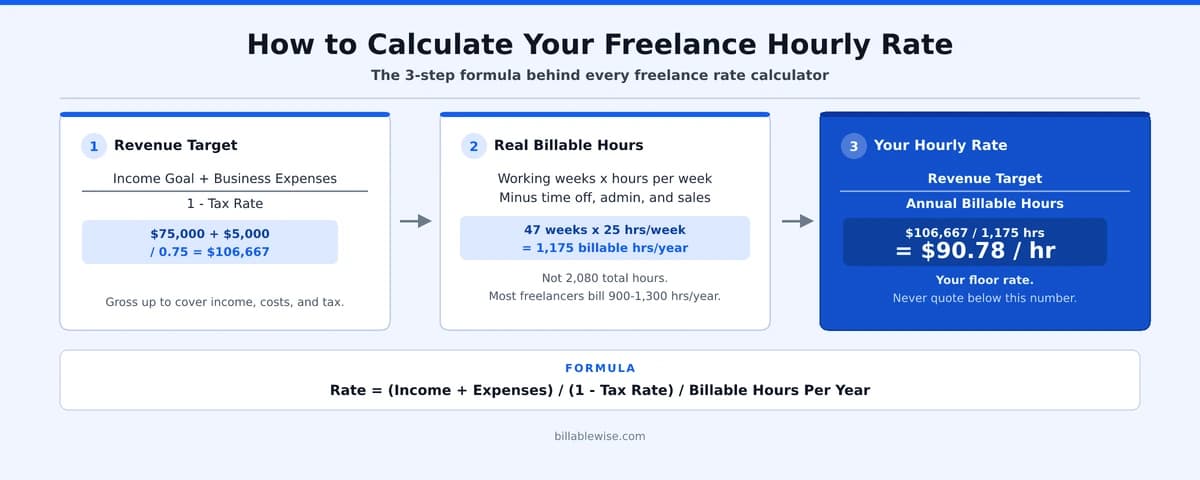
Use this freelance rate calculator when pricing hourly work, day-rate projects, retainers, salary replacement, or client proposals. Enter your annual or monthly income goal, business expenses, estimated tax rate, billable hours, and time off, and the calculator turns those numbers into an hourly rate, billable day rate, annual revenue target, and monthly revenue target.
A sustainable freelance rate covers far more than the hours spent on client work. It has to absorb admin time, sales calls, revisions, software, taxes, holidays, sick days, and every unpaid gap between projects. The calculator accounts for all of it.
How to Use the Freelance Rate Calculator
Set your income goal
Choose annual or monthly mode, then enter the net take-home income you want and the business expenses you need to cover.
Add tax and billable time
Enter your estimated tax rate, realistic billable hours per week, and planned time off so the rate is built on hours you can actually invoice, not total working hours.
Choose your field
Select your freelance discipline (development, design, writing, SEO, marketing, or consulting) to get benchmark rates and a project plan sized to your type of work.
Save or share your results
Copy your rate plan, share a pre-filled link, or download a full pricing report with your rates, revenue targets, and calculation steps.
The Formula Behind Every Freelance Rate Calculator
You do not need a tool to understand the math. You need five numbers, and each one matters more than most freelancers expect.
Step 1: Decide Your Take-Home Income Target
Start with what you actually want to keep after tax, not your gross earnings, not what you charged last year. If you want $70,000 net sitting in your account at year end, write down $70,000.
Most people anchor to their last salary. That is fine as a starting point, but it misses every cost freelancers carry that employees do not.
Step 2: Add Your Business Expenses
Freelance expenses are not optional. They are part of the cost of doing business, and ignoring them is one of the most common reasons freelancers feel underpaid despite charging reasonable rates. A realistic annual list includes:
- Software and subscriptions: design tools, project management, accounting apps
- Equipment: laptop depreciation, camera gear, peripherals
- Professional services: accountant fees, legal, contracts
- Marketing: website hosting, portfolio costs, any paid promotion
- Insurance: professional liability and self-paid health coverage
- Office or coworking: even a home office carries real costs
Most freelancers underestimate this figure by 30–40%. A conservative annual range runs from $3,000 to $12,000 depending on field and working setup. Add it to your income target; that combined figure is what your business must generate before tax.
Step 3: Gross Up for Tax
Tax does not come after you earn money. It comes out of the revenue your business generates. So if you need $75,000 take-home and your effective rate is 25%, you do not price your work to earn $75,000; you price it to generate the gross revenue that leaves $75,000 after tax.
The formula: Revenue Target ÷ (1 − Tax Rate)
Using those numbers: $75,000 ÷ (1 − 0.25) = $100,000 annual revenue target. That $25,000 difference is not profit. It is tax. Freelancers who skip this step chronically undercharge.
Self-employed tax obligations are typically higher than employed equivalents because you cover both sides of payroll taxes or national insurance. Use your effective marginal rate for this calculation, not the headline bracket rate.
Step 4: Count Your Real Billable Hours
This is the step most freelancers get wrong, and it is the single biggest reason a rate that looks correct on paper still leaves you short at the end of the year.
Your billable hours are not your working hours. They are the hours you can actually invoice a client for. A standard working year has roughly 2,080 hours. From that, subtract:
| Category | Typical Annual Hours Lost |
|---|---|
| Holidays and planned time off | 120–200 hrs (3–5 weeks) |
| Admin, invoicing, and email | 250–400 hrs |
| Sales, pitching, and proposals | 100–200 hrs |
| Non-billable revisions | 50–150 hrs |
| Sick days and personal time | 40–80 hrs |
What remains is often between 900 and 1,300 billable hours per year for a full-time freelancer. Not 2,080. Run your hours through that filter before doing the final calculation.
Step 5: Divide and Get Your Floor Rate
Hourly Rate = Annual Revenue Target ÷ Annual Billable Hours
Example: $100,000 ÷ 1,200 hours = $83.33/hr. That is your floor, not your ceiling, not the number you quote every client. It is the minimum below which you are effectively paying to work.
How to Calculate Your Freelance Day Rate
Once you have your hourly rate, a day rate takes one more step.
Day Rate = Hourly Rate × Billable Hours Per Working Day
If you bill 6 hours per day, realistic once you account for calls and admin within a working day, and your hourly rate is $83: $83 × 6 = $498/day. Round it. Quote it. Use it as your floor for day-rate contracts, workshops, and on-site work.
The phrase to anchor to is billable hours per day, not hours worked. Most freelancers are at their desk for 8 hours. Most can invoice for 5–7 of those. Use the number you can actually invoice, not the number you are sitting in your chair.
How to Calculate Your Freelance Rate From a Salary
This is one of the most searched questions in this space, and one of the most misunderstood. The common mistake: people take their salary, divide by 2,080 hours, and call it their freelance rate. Someone earning $65,000 decides their rate should be $31/hr.
That math ignores everything that made the salary work: employer pension contributions, paid holiday, health benefits, employer-side tax obligations, and the certainty of a monthly cheque regardless of whether clients pay on time.
The Actual Salary-to-Rate Conversion
Start with your gross salary target
The equivalent gross salary you want to replace, not your net take-home.
Add the value of employer benefits
Healthcare, pension, and paid leave you now self-fund. These are real costs that your rate must cover.
Add your business expenses
Software, equipment, insurance, and accounting: everything it costs to run your freelance practice.
Gross up for self-employment tax
Apply your full effective rate. Self-employed individuals typically pay more tax than employees at the same income level.
Divide by real billable hours
Not total working hours; the hours you can actually invoice clients for after removing admin, sales, and non-billable time.
In practice, someone replacing a $65,000 salary often needs to charge $55–$75/hr just to break even. Not $31. The "double your equivalent hourly salary" rule of thumb exists because it roughly accounts for these missing variables. But the BillableWise calculator runs the actual math for your specific situation.
Freelance Rates by Field: What the Benchmarks Actually Tell You
Benchmarks tell you what the market pays. Your calculator tells you what you need. The gap between those two numbers is your negotiating information.
| Field | Entry | Mid-Range | Experienced |
|---|---|---|---|
| Developer | $50/hr | $75–$120/hr | $150+/hr |
| Designer | $35/hr | $55–$90/hr | $110+/hr |
| Content Writer | $25/hr | $35–$60/hr | $80+/hr |
| SEO Specialist | $30/hr | $45–$75/hr | $95+/hr |
| Marketing Freelancer | $30/hr | $40–$70/hr | $90+/hr |
| Consultant | $75/hr | $100–$175/hr | $200+/hr |
If your calculated floor falls within the mid-range for your field, you are in a healthy position. If it falls above the experienced ceiling, you have a cost or capacity problem: too many expenses, too few billable hours, or income expectations that need a client positioning change. If your floor falls below the entry range, that is a pricing opportunity you are not capturing.
Freelance Design Rate Calculator
Design pricing carries extra complexity: projects are usually sold as fixed-price deliverables, not hourly work. Your calculated hourly rate becomes an internal benchmark. A logo project that takes 12 hours at $75/hr should never leave your desk quoted below $900, regardless of how fast it looks like it was produced. Most design projects also run 20–30% over the initial time estimate once client feedback cycles are factored in. Build that buffer into your rate, not into your stress level.
Freelance Writing Rate Calculator
Content writers frequently encounter per-word rate offers. To sanity-check any offer, divide the per-word rate by your typical output per hour and compare to your floor. If a client offers $0.10/word and you write 500 words/hour, that is $50/hr; whether that clears your floor depends entirely on your numbers.
Freelance Developer Rate Calculator
Developers have the widest rate variance of any freelance field; a junior and a senior architect can sit 4× apart in the same market. That makes anchoring to your own financial floor especially important, rather than anchoring to whatever someone else told you the market pays.
Freelance Tax Rate Calculator
Some people search for a freelance tax rate calculator specifically to understand what tax they owe, not how to price their work. Those are two separate calculations. For tax liability, use tax software or an accountant. For pricing your work to cover tax, this calculator handles the gross-up math automatically.
Does Your Location Affect Your Freelance Rate?
It affects the market rate: what clients in your geography expect to pay. It does not change your floor rate: what you actually need to earn.
UK Freelancers
A freelance rate calculator for UK work needs to account for National Insurance on top of income tax. Self-employed NI can add 9–11% to your effective burden at moderate income levels. Someone targeting £50,000 net needs to generate roughly £72,000–£78,000 gross before accounting for business expenses, a meaningful gap that many freelancers miss when setting their rates.
Australian Freelancers
GST applies to freelance income above $75,000 AUD annually. Below that threshold it can be ignored for pricing. Above it, GST adds a mandatory 10% that clients generally expect to see listed separately on invoices. Factor it into your quoting process clearly, or it will come out of your margin.
Canadian and US Freelancers
Both markets have strong demand for skilled independent workers. US freelancers in major tech markets (New York, San Francisco, Seattle) routinely command 20–35% rate premiums over national averages. Canadian freelancers increasingly price in USD for US clients, which produces a meaningful exchange rate advantage. The BillableWise calculator supports USD, GBP, AUD, CAD, EUR, PKR, INR, AED, SAR, JPY, CNY, and NZD.
Tax and Your Freelance Rate: What to Actually Include
One of the most persistent questions: when calculating your freelance rate, should you add in tax? Yes. Always. Without exception.
The nuance is in how. The tax input in this calculator is not your income tax bracket; it is your effective marginal rate, the percentage of your next dollar of freelance income that actually goes to tax after deductions.
General ranges by market:
- US: 20–30% effective rate for moderate incomes, combining federal income tax and self-employment tax
- UK: 30–42% at mid-range incomes, including income tax and NI contributions
- Australia: 32–39% at equivalent mid-range incomes
- Canada: 25–35% depending on province and personal deductions
These are not precise figures for your situation. Your accountant gives you that number. But plugging in 25% as a default gets most freelancers surprisingly close. The bigger mistake is inputting 0%, which happens when people enter their gross income goal without realising the calculator expects a net figure. They wonder why they feel financially flat despite charging what feels like a good rate.
The Billable Hours Trap: Why Your Rate Always Feels Wrong
Most freelancers set a rate, run with it for a year, and finish the year feeling underpaid. They raise it slightly. The feeling persists.
The actual culprit is usually billable hours, specifically overestimating them at the start. In year one of freelancing, most people realistically bill 800–1,000 hours. They planned for 1,400. They priced for 1,400. The result is a 30–40% income shortfall, not because the rate was wrong, but because the denominator was.
The fix is recalculating every six months using real hours, not projected ones. Track your time. Run the numbers again. Adjust before the gap compounds into another year of underearning.
Your Rate Is a Moving Target: Treat It That Way
The rate you set in year one is not your rate for year three. Expenses shift. Skills compound. Client quality improves. The number of projects you need per month should decrease as your average project value grows, which only happens if your rate grows with it.
Set a rate today that keeps you financially solvent. Schedule a review every six months. Plug your real expenses, real hours, and real income target into the calculator and see where the math has moved. Run that check in under two minutes. Adjust before you need to, not after you have already undercharged three clients and extended a contract you should have repriced.
Your rate is not a guess. It is math. Let the math work for you.
FAQ
How do I calculate my freelance hourly rate?
Add your target take-home income and business expenses, adjust for your estimated tax rate, then divide the revenue you need by your realistic billable hours. The calculator does this for annual or monthly goals.
Is this a freelancer hourly rate calculator?
Yes. BillableWise works as a freelancer hourly rate calculator by turning your income goal, expenses, tax estimate, billable hours, time off, field, and currency into a suggested hourly rate.
How do I calculate a freelance day rate?
Use your calculated hourly rate and multiply it by the number of billable hours you can realistically sell in a day. BillableWise shows a billable day rate automatically from your weekly billable hours.
Can I calculate a freelance rate based on salary?
Yes. Use the salary you want to replace as your income goal, then add freelance-only costs such as taxes, insurance, software, equipment, unpaid time off, and non-billable admin time.
Should a freelance rate include taxes and expenses?
Yes. A sustainable freelance rate should include business expenses, software, equipment, admin time, unpaid time off, and a tax estimate. The tax input is an estimate, not tax advice.
Can I use this as a freelance tax rate calculator?
You can use it to see how an estimated tax percentage changes your required freelance hourly rate, day rate, and revenue target. It does not calculate official local tax liability.
Can I calculate rates for design, writing, development, marketing, SEO, or consulting?
Yes. Choose a freelance field such as developer, designer, content writer, SEO specialist, marketing freelancer, or consultant to get field-aware project and pricing suggestions.
Does this freelance rate calculator work for the UK, Australia, India, Canada, and other countries?
Yes. You can choose currencies such as USD, GBP, AUD, CAD, INR, PKR, EUR, AED, SAR, JPY, CNY, and NZD. Enter your own local tax estimate and expenses for the most useful result.
Can I use this for calculating freelance rates for projects?
Yes. Use the hourly result as your internal floor, then estimate project fees, day rates, retainers, and monthly revenue needs from that rate.
Freelance pricing guides
Use these guides alongside the calculator to understand the math behind your hourly rate, beginner pricing, and salary break-even point.
Career math
Salary vs. Freelance: The Exact Number You Need to Break Even
Find the exact freelance hourly rate you need to break even with a salary after taxes, benefits, overhead, unpaid admin time, dry months, and realistic billable hours.
Read guideBeginner pricing
Freelance Rates for Beginners: Start Here Before You Quote Anyone
New to freelancing? Learn the exact formula for calculating your freelance rate with real numbers, beginner pricing mistakes to avoid, and how to quote with more confidence.
Read guidePricing basics
How to Calculate Your Freelance Hourly Rate
Learn how to calculate your freelance hourly rate step by step - from income goals and business expenses to taxes, billable hours, and time off. Free calculator included.
Read guide