
Freelance Rates for Beginners: Start Here Before You Quote Anyone
Most new freelancers either charge too little and burn out, or quote too high and lose clients they actually wanted. Here is how to figure out the number that is actually right for you.
Key takeaways
- Your rate should come from your own income goal, expenses, taxes, and billable hours.
- Copying another freelancer or converting an old salary usually creates a rate that does not work.
- Most freelancers cannot bill 40 hours per week, so your rate has to account for unpaid business time.
- A lower starter rate can be useful only when it is intentional, temporary, and tied to proof or referrals.
- Once you know your hourly floor, you can choose hourly, project, or retainer pricing more confidently.

The first time a client asks what you charge, it can feel like a trap. Say too much and you worry you will lose them. Say too little and you may resent the project three weeks later while still doing the work. Most beginners pick a number that feels reasonable and hope it holds.
The problem is that reasonable is usually way off. Not always too high. More often, too low. A rate that is too low does not just hurt your wallet. It shapes how clients treat you, how much energy you have left for the work, and whether freelancing feels sustainable or exhausting.
Before you quote anyone, spend a little time with the actual math. Your rate should not come from what someone online said, what your friend charges, or what sounds humble enough not to scare people away. It should come from your specific situation.
Use the BillableWise calculator to turn your income goal, expenses, taxes, and billable hours into a realistic hourly rate.
What is a good freelance rate for beginners?
A good beginner freelance rate is high enough to cover your real costs and low enough that you can sell your first projects while building proof. That does not mean you should be cheap. It means your rate should be based on math, market reality, and a clear plan for raising prices as your proof improves.
Your first number does not have to be perfect forever. It needs to be honest enough that you are not quietly losing money every time a client says yes.
The ways most beginners get this wrong
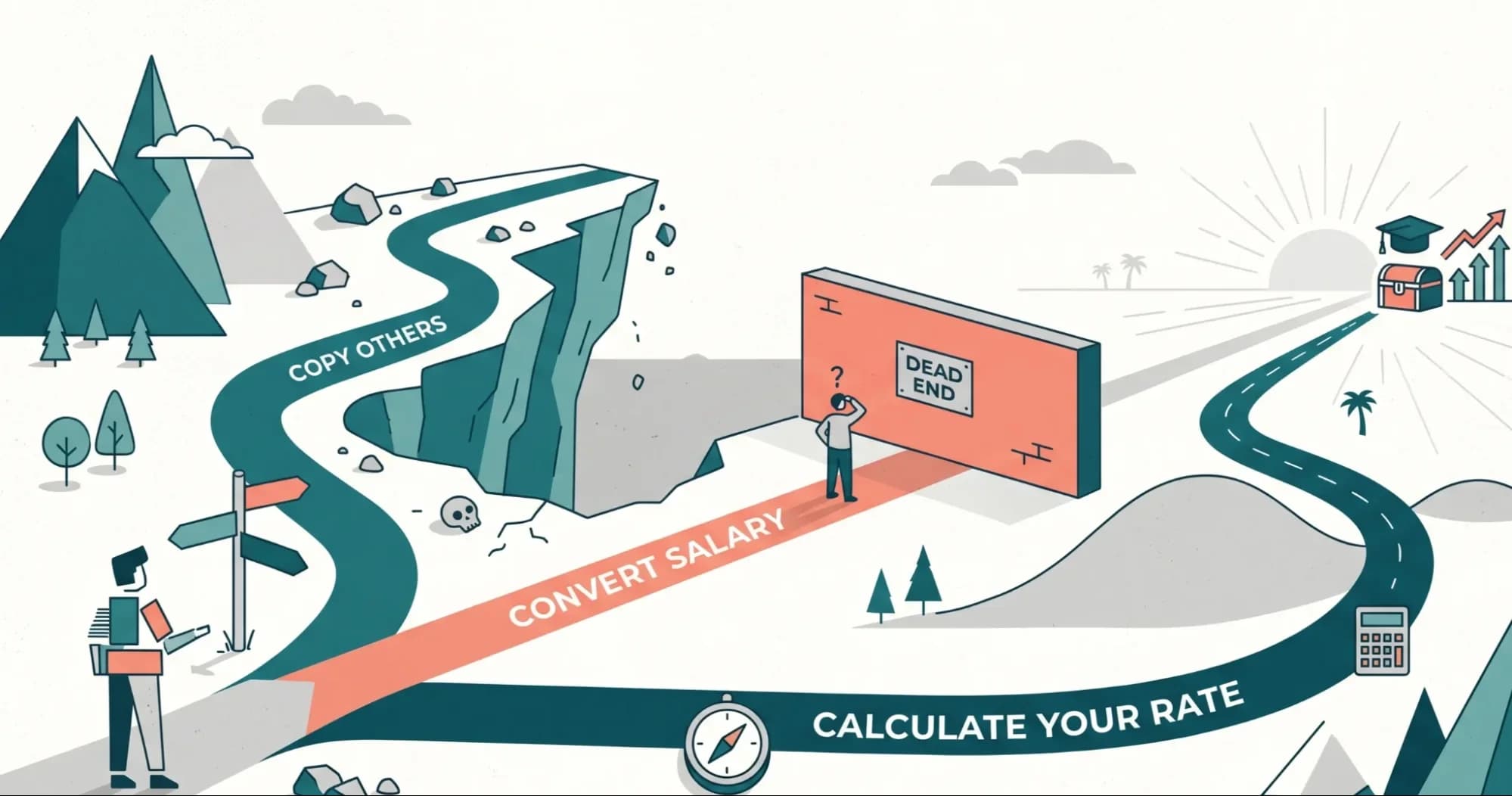
There are three pricing patterns beginners fall into constantly, and they all produce the same outcome: a rate that does not actually work.
Copying someone else
You see a designer on Twitter saying they charge $85/hr and think, okay, you will do $75/hr because you are newer. But you do not know their expenses, country, tax situation, how many hours they actually bill, or whether that rate is even working for them. You are building your business on someone else's guess.
The salary conversion trick
Take your old $55,000 job, divide by 52 weeks, divide by 40 hours, land around $26/hr, and call it done. This falls apart once you realize your employer covered taxes, equipment, software, health insurance, paid time off, and the fact that you will not have 40 billable hours per week.
Going low on purpose
Charge less than you think you are worth so clients do not say no. This feels safe, but it attracts clients who always push back on price, builds your reputation at the wrong level, and creates a ceiling that is hard to break through later.
What the math actually looks like
Here is the core idea: your hourly rate needs to cover everything your business costs you, plus taxes, plus what you actually want to take home. And it needs to do all of that across only the hours you can realistically bill each week.
Let's go through each piece so it actually makes sense.
Your income goal
This is the number you actually want in your bank account after everything. Not your revenue. Not your gross. The real take-home amount you need to cover your life, whether that means rent, food, savings, or whatever your actual situation requires.
Be honest about it. A lot of people lowball this because they feel weird asking for more, but the goal here is accuracy, not modesty. If you need $4,500 a month to live without stress, that is your number.
Business expenses
This is the part most new freelancers skip completely, and it always catches up with them. Running a freelance business costs money. Not a huge amount, but more than zero, and it needs to be factored into your rate because nobody is paying these for you anymore.
Think about the tools you use. Some examples:
- Invoicing software, design tools, or developer subscriptions
- Your laptop, and what it will eventually cost to replace
- The work portion of your internet bill
- Courses you buy, a portfolio site, or marketing
- An accountant, bookkeeper, lawyer, or contractor if you use one
Add it up across a year. For most solo freelancers this lands somewhere between $4,000 and $12,000 annually depending on your field. That money has to come from somewhere, and it should come from your rate.
Tax
Nobody warns you about this loudly enough. When you are freelancing, clients pay you the full invoice amount and then you owe tax on it later, sometimes a lot of tax. Depending on where you are, you might owe income tax plus self-employment tax, which can push your effective rate well past 30%.
The safest thing you can do is treat a chunk of every payment as money that was never yours. Most freelancers set aside somewhere between 20% and 35%. If you are unsure, talk to an accountant in your country. One hour with them at the start of your freelance career can save a lot of pain later.
For the math, all you need is an estimate. We will use 25% for now.
Billable hours are smaller than you think
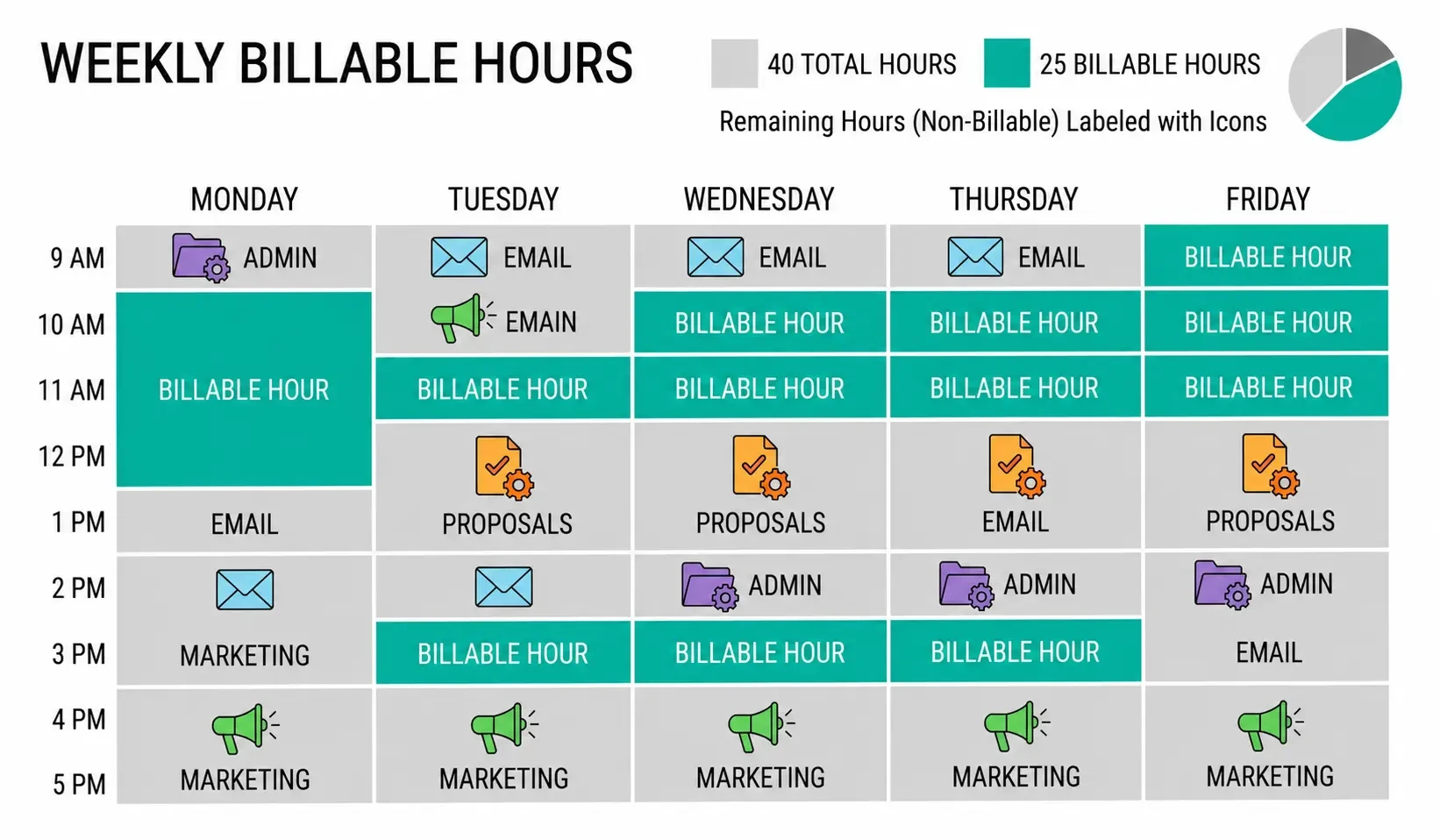
This is the one that surprises people the most. You are not going to bill 40 hours a week. You are probably not even going to bill 30.
Between writing proposals, going back and forth on emails, chasing invoices, doing your own marketing, updating your portfolio, sitting on calls that do not convert, dealing with revisions that were not in the original scope, and the general overhead of running a small business, the hours you can actually bill a client for are much fewer than the hours you are working.
A realistic number for most freelancers is somewhere between 20 and 28 hours per week. If you are brand new and still figuring things out, use 20. Then take out your time off, including holidays, sick weeks, and the week between projects where nothing lines up. Budget about four to six weeks off per year, which leaves roughly 46 to 48 working weeks.
Running the numbers for real
Here is a worked example. You want to take home $50,000 a year. Business expenses run about $10,000 annually. Tax rate is 25%. And you can realistically bill 25 hours a week across 48 weeks.
| What we are calculating | The number |
|---|---|
| Take-home income goal | $50,000 |
| Annual business expenses | $10,000 |
| Combined total needed | $60,000 |
| Gross revenue needed (after 25% tax) | $80,000 |
| Total billable hours per year | 1,200 |
| Minimum hourly rate | $66.67/hr |
$67 an hour. That is the floor. Go below that and you are not actually hitting your goal. You are just telling yourself you are.
A lot of beginners see a number like that and immediately think it is too high. But compare it to what you would need to earn as an employee to take home $50,000, factoring in employer benefits, paid leave, equipment your job covers, and the fact that you are not dealing with any of the business overhead yourself. The freelance number needs to be higher precisely because you are now covering all of that yourself.
What if you are too new to justify the rate?
This is the real question for most beginners and it is worth being honest about. Yes, clients pay for experience. And yes, when you are new, you do not have a track record to point to. But your bills do not care about that.
What actually works, and what will not destroy you financially, is taking one or two projects at a slightly reduced rate on purpose, as a deliberate choice, with a specific client who can give you something in return: a solid testimonial, a case study you can share, or a referral to someone in their network. You are not working cheap because you have to. You are making a short-term investment in your portfolio with a client you have actually vetted.
The difference between this and just charging low because you are scared is intention. One has an endpoint and a return. The other just becomes your rate forever.
After your first few projects, revisit the number. Most freelancers raise their rate meaningfully after three to five clients because by then they have proof of what they deliver, and proof changes the conversation entirely.
Hourly, project, or retainer?
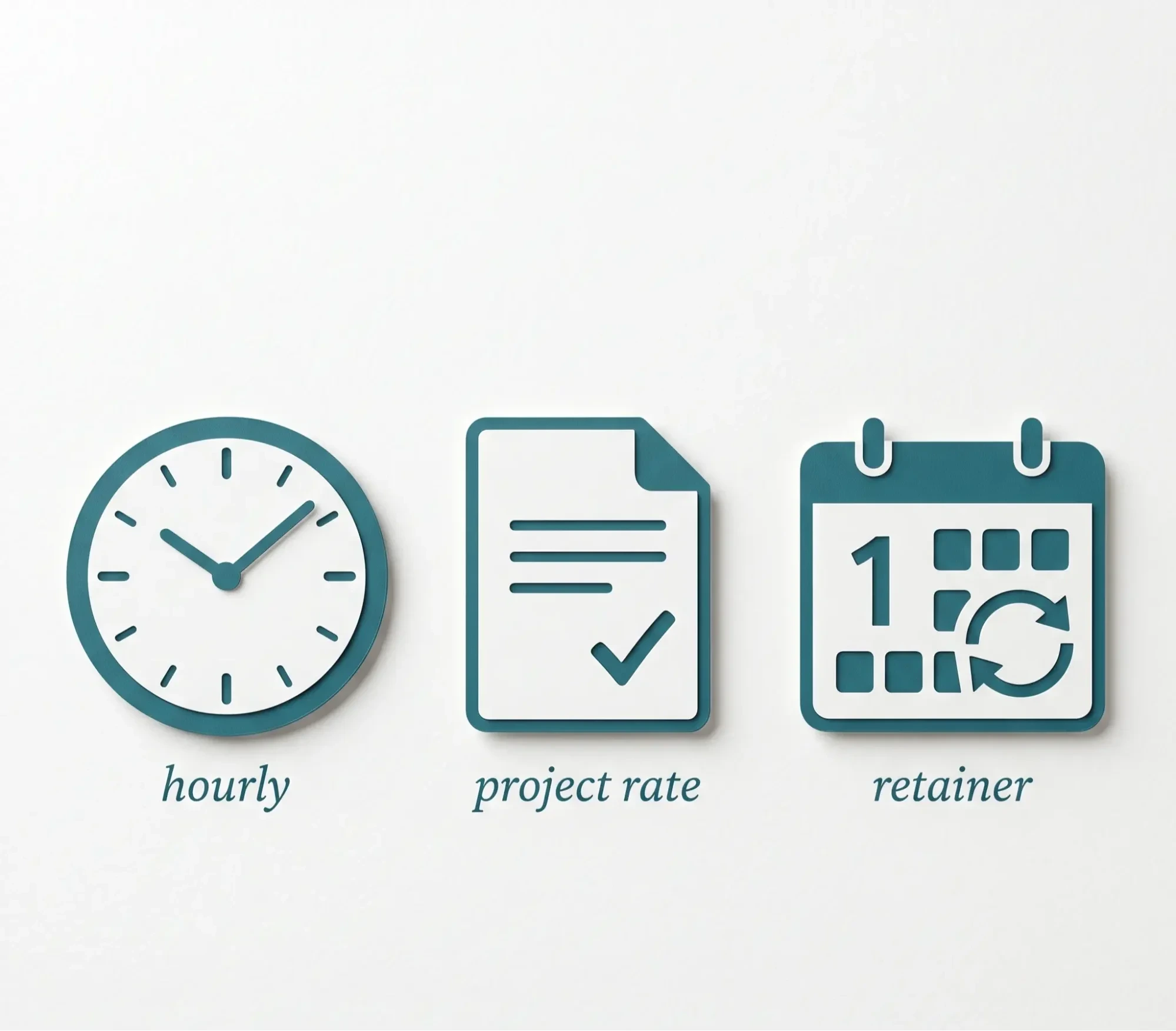
Once you know your floor rate, how you charge is a separate decision. You have three practical options.
Simple to start
Hourly
You track your time and bill for what you worked. It works well for ongoing, open-ended work where the scope is not fully defined. The downside is that it can feel like a ceiling as you get faster.
Clear for clients
Fixed project
You quote a flat fee for the whole job. Estimate the hours, multiply by your rate, add a buffer for the unexpected, and that is your number. Clients often prefer this because they know what they are paying.
More predictable
Retainer
A client pays you a set amount each month for an agreed amount of work. Your income becomes predictable. You spend less time selling and build a real relationship instead of constantly pitching new clients.
Skip the guesswork entirely
Everything in this article, including the income goal, expenses, tax estimate, and billable hours, feeds into the BillableWise rate calculator. Put in your actual numbers and it will give you your minimum hourly rate, your day rate, your monthly revenue target, and an estimate of how many projects per month you would need based on your field.
It is free and takes about two minutes. No account, no email, just a number you can actually use.
Use your actual numbers and get a minimum hourly rate, day rate, revenue target, and project estimate.
Before you go
Your rate is not a personality trait. It is not a statement about how confident you are or how much you believe in yourself. It is a number that comes from your costs, your time, and your goals. When you treat it that way, the whole conversation with clients gets a lot easier.
You are not asking for a favor when you quote your rate. You are telling someone what it costs to work with you. That is a normal business transaction, and the math behind it is simpler than it feels right now.
Run the numbers. Know your floor. Then go have the conversation.
Next steps
Career math
Salary vs. Freelance: The Exact Number You Need to Break Even
Find the exact freelance hourly rate you need to break even with a salary after taxes, benefits, overhead, unpaid admin time, dry months, and realistic billable hours.
Read guidePricing basics
How to Calculate Your Freelance Hourly Rate
Learn how to calculate your freelance hourly rate step by step - from income goals and business expenses to taxes, billable hours, and time off. Free calculator included.
Read guide